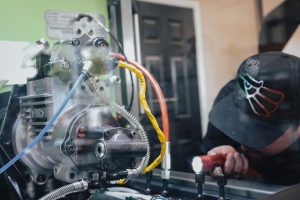
Precision Pump Testing: Verifying Output, Pressure Curves, and Dynamic Response Under Stress
With over 92.3 million pump units deployed globally, their reliability is non-negotiable. But what happens when these critical components are pushed to their limits? Standard performance tests, conducted in ideal conditions, often fail to predict how a pump will behave under real-world operational stress. This article explores the vital practice of precision pump testing under duress, verifying performance when it matters most.
Samperio Turbo strictly works with diesel turbochargers, injectors and fuel pumps, but strive to share information on turbos/injectors etc in general. Enjoy the article!
We are Samperio Turbo Rebuild—where precision meets performance
We are Samperio Turbo Rebuild, a trusted leader in diesel turbocharger repair, rebuilding, and maintenance services. With a strong commitment to quality and customer satisfaction, we specialize in providing top-notch solutions for all types of turbochargers, ensuring your vehicle runs at peak performance. Our team of highly skilled technicians uses the latest technology and industry best practices to deliver reliable and efficient services. At Samperio Turbo Rebuild, we don’t just fix turbos; we enhance your vehicle’s performance and extend its lifespan.


Beyond Standard Performance – Why Pumps Need Stress Testing
The Critical Role of Pumps in Modern Systems
From industrial manufacturing to heavy-duty diesel engines, pumps are the circulatory system of modern technology. Their failure can halt production, cripple equipment, and lead to catastrophic financial loss. In a global market expected to reach USD 81.62 billion by 2030, the demand for robust and reliable pumps has never been higher.
The Inadequacy of Standard Testing: Unveiling Hidden Vulnerabilities
Standard testing validates a pump’s performance at its design point. However, it rarely accounts for the sudden pressure spikes, temperature fluctuations, and variable loads that define actual operating environments. This gap leaves systems vulnerable to failures that were never anticipated in the sterile conditions of a lab.
A New Paradigm: Applying the “Stress” Metaphor to Pump Performance
Just as humans experience a stress response, so do mechanical systems. Pushing a pump beyond its normal operating parameters triggers reactions that can reveal its true resilience—or its breaking point. This is not about mental health, but mechanical health. Understanding this mechanical “stress response” is key to ensuring long-term durability.
What This Article Will Cover: Output, Pressure Curves, and Dynamic Response Under Duress
We will delve into the three pillars of precision stress testing: verifying consistent output under load, analyzing how pressure curves change under duress, and measuring a pump’s dynamic response to sudden system changes.
Defining "Stress" for Industrial Pumps: An Operational Perspective
For a pump, stress isn’t emotional; it’s a measurable set of conditions involving pressure, temperature, vibration, and load that push it to the edge of its design specifications.
Understanding the “Window of Tolerance” for Pumps
Every pump has an optimal operating range. Stress testing identifies the boundaries of this window, determining where performance begins to degrade and failure becomes imminent.
The Pump’s “Fight or Flight” Response: Operating at System Limits
A pump’s “fight” response is its ability to maintain performance during a sudden surge in demand. “Flight” can be seen as a controlled reduction in performance to avoid catastrophic failure. Testing these reactions is crucial for predicting reliability in volatile systems.
The “Freeze” or Shutdown Response: When Protective Measures Activate
When stress exceeds a critical threshold, protective systems may trigger a shutdown. Understanding the causes of this “freeze” response prevents unnecessary downtime and helps diagnose underlying system issues.
“Chronic Stress” in Pumps: The Gradual Degradation of Performance
Like chronic stress on the human body, continuous operation under non-ideal conditions leads to premature wear. This gradual degradation, often invisible during standard checks, is a primary cause of unexpected equipment failure.
Why Standard Pump Testing Falls Short: Limitations of Ideal Conditions
Traditional testing methodologies provide a baseline but fail to capture the full picture of a pump’s operational capabilities.
Traditional Performance Testing: Focus on Design Points and Stable Flow
Standard tests confirm that a pump meets its datasheet specifications under stable, predictable conditions. While useful, this data represents a best-case scenario, not the typical operating reality.
The Gap: Unaccounted Real-World Operational Dynamics
The real world is messy. It includes pressure hammering, fluid contamination, and operator error—factors that create performance symptoms standard tests miss.
The Cost of Neglect: Premature Failure, Downtime, and Inefficiency
Neglecting stress testing can lead to catastrophic failures. For industrial operations, unplanned downtime costs a minimum of $10,000 per hour, turning a preventable issue into a major financial crisis.
The Pillars of Precision Pump Testing Under Stress
A comprehensive stress test focuses on three core performance indicators.
Verifying Output Under Stressful Conditions
This involves confirming that the pump maintains its required flow rate even when subjected to high back-pressure, temperature changes, or other stressors. In the heavy-duty pump market, valued at over $118 billion, consistent output under stress is paramount.
Analyzing Pressure Curves Under Duress
A pump’s pressure curve is its signature. Under stress, deviations from the ideal curve—like pressure drops or erratic spikes—can indicate issues like cavitation or internal wear long before total failure occurs.
Dynamic Response: The Pump’s Reflexes to Change
This measures how quickly and accurately a pump adapts to rapid changes in demand. A slow or unstable response can destabilize an entire system. Predictive maintenance, which monitors these dynamic reactions, can reduce unplanned failures by 40%.
Identifying and Simulating Operational Stressors for Pumps
Effective testing requires recreating the specific challenges a pump will face in its intended application.
Common Operational Stressors (The “Causes” of Pump Stress)
Key stressors include fluid viscosity changes, cavitation (the formation of vapor bubbles), aeration, high-vibration environments, and extreme thermal cycling. Each of these can be a primary cause of premature wear.
Designing Robust Stress Test Scenarios
A robust test scenario might involve rapid cycling between high and low-pressure states, introducing controlled fluid temperature changes, or simulating a “dead head” condition where the outlet is blocked.
Essential Tools and Methodologies for Precision Stress Testing
Advanced instrumentation and data analysis are the foundation of modern stress testing.
Advanced Instrumentation and Sensors for Comprehensive Data Collection
High-speed pressure transducers, flow meters, vibration analyzers, and thermal imagers are essential tools for capturing a complete performance picture.
Data Acquisition and Analysis: Building the “Stress Log”
Continuous data logging creates a “stress log” that maps pump reactions to specific events, providing invaluable diagnostic insights.
Test Rig Design Considerations for Simulating Diverse Stressors
A versatile test rig should allow for precise control over flow, pressure, and temperature, enabling the simulation of a wide range of operational conditions.
Interpreting the "Symptoms of Stress": Diagnostics and Troubleshooting for Pumps
The data collected during stress tests reveals the “symptoms” of a struggling pump.
Recognizing Anomalies in Output and Pressure Curves
Sudden drops in flow or erratic pressure readings are clear indicators of underlying problems that need immediate attention.
Identifying Mechanical and Vibrational Indicators
Increased noise or abnormal vibration frequencies often point to mechanical issues like bearing wear or impeller imbalance.
Troubleshooting Strategies Based on Stress Test Data
By correlating performance anomalies with specific stressors, technicians can accurately diagnose root causes and implement effective, targeted repairs, moving from reactive fixes to proactive maintenance.
Building Reliability Where It Truly Counts
Precision pump stress testing moves reliability from assumption to certainty. By pushing pumps beyond ideal conditions and observing how they respond under real-world pressure, engineers gain the insights needed to prevent failure, reduce downtime, and extend equipment life.
Stress testing exposes hidden vulnerabilities, validates true operating limits, and transforms maintenance from reactive guesswork into proactive control. In systems where failure is costly and reliability is non-negotiable, testing pumps under duress isn’t an extra step—it’s the standard that ensures performance holds when conditions are at their toughest.